Missing depth data
Viewpoint and occlusion prevent complete depth reconstruction.
Fine motor research for non-human primates
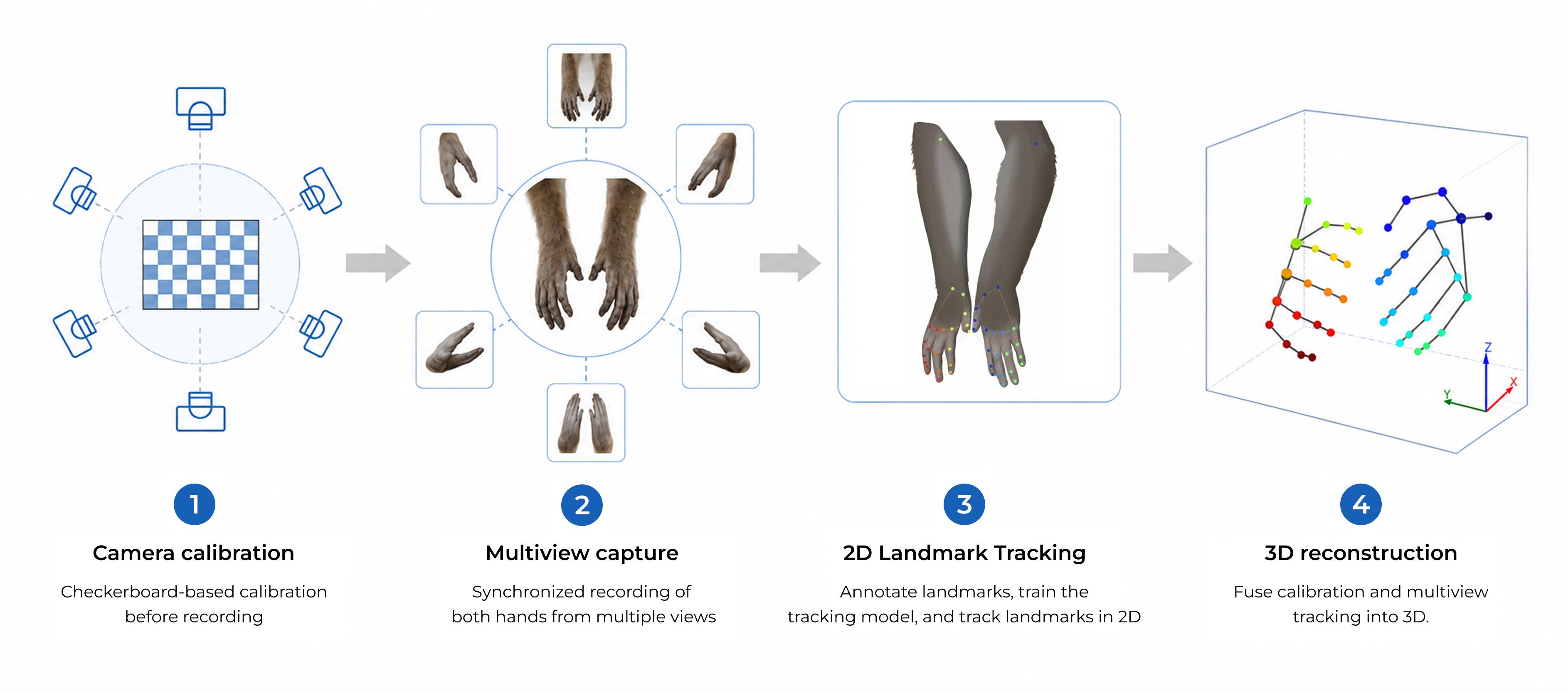
Markerless 3D reconstruction of 44 bilateral hand keypoints using six synchronized cameras and deep learning.
RESEARCH CHALLENGE
Hand motion links behavior to neural mechanisms, yet conventional methods miss fast, subtle and occluded finger movements.
Viewpoint and occlusion prevent complete depth reconstruction.
Time-consuming, subjective and difficult to scale.
Markers alter natural behavior and are unsuitable for long studies.
SOLUTION
An integrated pipeline spanning synchronized capture, AI detection, reconstruction, validation and export.
44-POINT MODEL
Twenty-two standardized keypoints per hand cover the elbow, wrist and every finger segment for complete bilateral motion analysis.
3D RECONSTRUCTION / BI-MANUAL KEYPOINTS
3D reconstruction demo
REFERENCE CHAIN / MOTION BASE
FINE JOINTS / SEGMENT ANALYSIS
CORE CAPABILITIES
Every layer, from capture hardware to analysis, is designed for fine hand movement research.
Preserve more natural behavior with no physical markers.
High-speed multi-angle coverage of the hand workspace.
Optimized for primate hand anatomy and fine movements.
Automatic processing from video to coordinates and visualization.
Adapt to species, subjects, lighting, cages and tasks.
Sub-centimeter accuracy validation plus optional Kalman filtering.
SYSTEM PERFORMANCE
Supports server deployment and local deployment based on data security, compute and collaboration needs.
DATA OUTPUT
Output files preserve the complete chain from 2D detection to 3D reconstruction for review, visualization and analysis.
2D keypoint sequencesPer-camera detection results
2D CSV2D tracking videosQuick quality review
VIDEO3D coordinate sequences44-point standardized motion data
3D CSV3D reconstruction videoVisualize complete movement
VIDEOAccuracy reportQuantified sub-cm reconstruction accuracy
REPORTRESEARCH APPLICATIONS
Study regulation across fingers, wrist and forearm.
Quantify strategies across objects and task difficulty.
Align with electrophysiology, imaging or neuromodulation.
Analyze motor deficits in Parkinson’s and spinal injury models.
Compare fine movement before and after interventions.
Study bimanual coordination and goal-directed behavior.
CUSTOM SOLUTION
Configure the full solution around your site, species, model, interfaces and deployment needs.
Site survey and six-camera layout
Species, subject and environment adaptation
Customer-data annotation and model training
Custom keypoints and skeleton topology
Device synchronization and data interfaces
Server and local deployment configuration
Unified keypoint definitions and 3D coordinates establish a standardized base for cross-study comparison, review and future databases.